The automotive industry is undergoing one of its most significant transformations in decades. Electrification, increasingly complex materials, new global quality standards, and strong pressure to reduce the cost of non-quality have made visual inspection a critical step in modern production lines.
To meet the zero-defect targets demanded by OEMs and their supply chain, traditional inspection technologies are no longer sufficient.
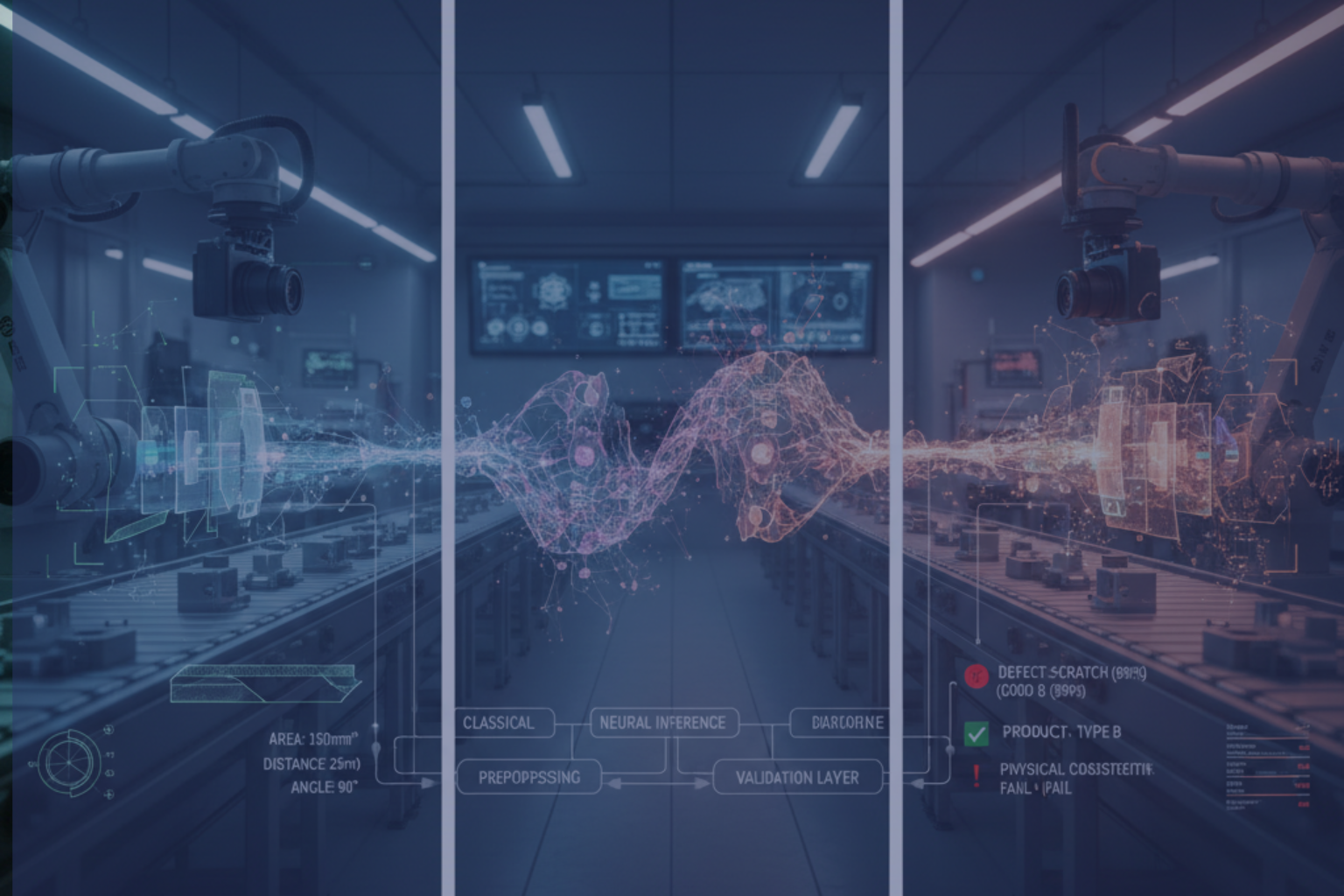
In this context, specialized companies such as ISR are leading the transition towards an advanced inspection model powered by artificial intelligence and specular vision, technologies capable of detecting defects invisible to the human eye and stabilising processes even on high-speed production lines.
This article explores why conventional vision systems are falling behind, how AI is reshaping automotive inspection, and the concrete benefits that specular vision brings to OEMs and Tier 1 and Tier 2 suppliers.
1. Current Challenges in the Automotive Sector (2025–2030)
Quality control in automotive manufacturing faces increasingly demanding challenges:
1. Rise of glossy components and premium finishes
EV design trends have significantly increased the use of Black Piano surfaces, high-gloss coatings, polished aluminium and complex geometries.
2. “Zero defects” as a mandatory standard
OEMs no longer accept variability. Audits, dimensional checks and PPAP protocols are stricter than ever.
3. Proliferation of materials that are difficult to inspect
High-gloss plastics, composites, reinforced polyester and components with pronounced curvature, among others.
4. Mandatory digitalisation of quality control
End-to-end traceability and connectivity with MES/ERP systems have become essential, particularly for Tier 1 suppliers.
5. Pressure to reduce the cost of non-quality
A single superficial defect can lead to:
- OEM rejections,
- large-scale returns,
- line stoppages,
- and high rework costs.
In this scenario, visual inspection must become more precise, faster and fully automated. This is where ISR’s technology delivers a decisive advantage.

2. Why Traditional Visual Inspection is No Longer Enough
2.1. Limitations of Manual Inspections
The human eye is extraordinary, but it was never designed to inspect thousands of parts a day under artificial lighting and highly repetitive conditions. Common limitations include fatigue, subjectivity, variability between work shifts, lack of traceability, and inconsistency in high-speed processes. These challenges are particularly pronounced when dealing with glossy materials or curved geometries, where human error increases significantly.
2.2. Limitations of Conventional Machine Vision (2D / 3D)
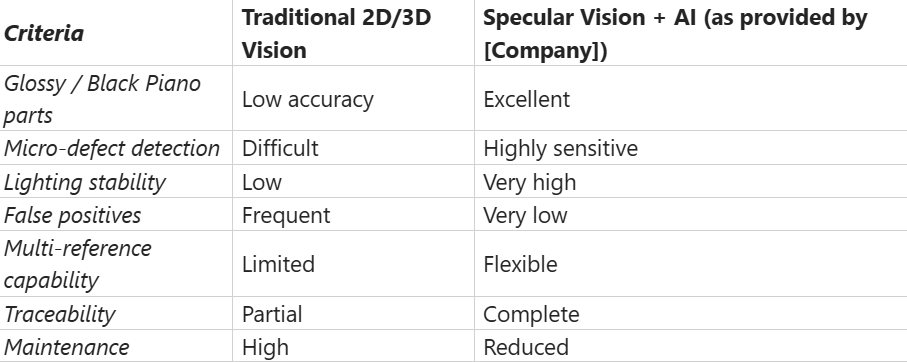
Traditional vision systems based on 2D or 3D imaging often struggle to inspect surfaces where light does not behave uniformly. Frequent issues include uncontrolled reflections, shadows, overexposed or saturated areas, insufficient contrast, and an inability to detect micro-deformations. These limitations frequently lead to false positives, false negatives, and low repeatability. Consequently, an increasing number of manufacturers are turning to advanced technologies, such as specular vision combined with artificial intelligence, a field in which ISR has developed deep expertise.

3. What is AI-Based Visual Inspection with Specular Vision?
The Advantage of Specular Vision
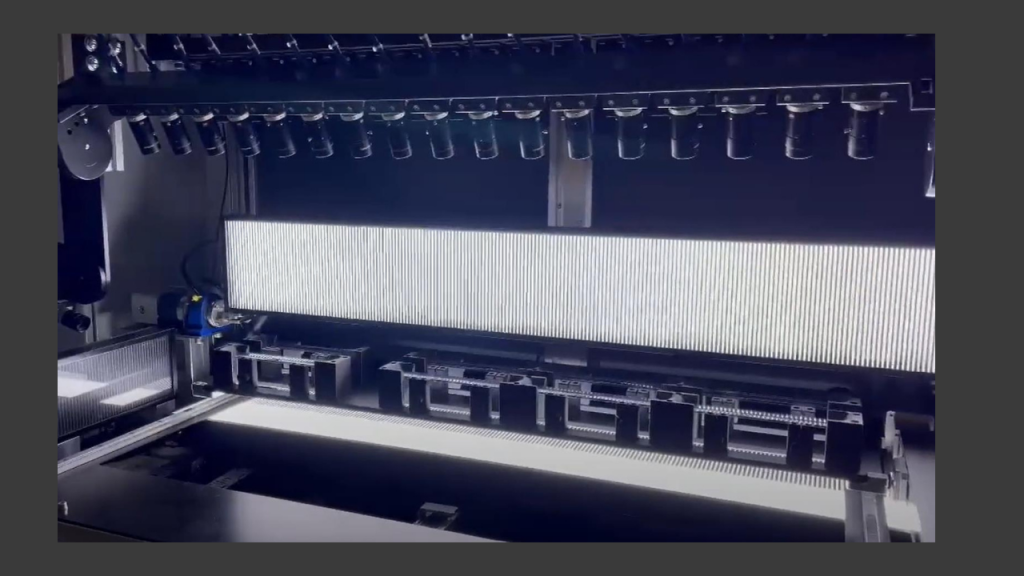
Specular vision works by illuminating the part with a controlled lighting pattern and analyzing how the reflections deform across its surface. This approach enables the detection of defects that do not produce visible contrast, including micro-scratches, surface waves or undulations, orange-peel texture, dents, contamination, paint imperfections, and minor deformations. On glossy or black components, specular vision achieves significantly higher accuracy than traditional 2D vision systems, particularly when identifying low-contrast or barely visible defects.
The Role of Artificial Intelligence
The AI developed by ISR enables the training of models specific to each part reference, distinguishes normal process variations from actual defects, drastically reduces false positives, maintains stability on high-speed production lines, and adapts to complex geometries. When combined with specular vision, this AI achieves a level of sensitivity that surpasses both the human eye and conventional machine-vision systems.
What is AI-Based Visual Inspection in Automotive?
AI-based visual inspection in automotive is an automated system that uses industrial cameras, deep-learning algorithms and advanced techniques such as specular vision to detect surface defects in metallic, plastic or painted components. It enables OEMs, Tier 1 and Tier 2 suppliers to achieve zero-defect quality standards, strengthen traceability and significantly reduce the cost of non-quality.
Benefits for OEM, Tier 1 and Tier 2
OEM
- Guaranteed quality for high-visibility interior and exterior components.
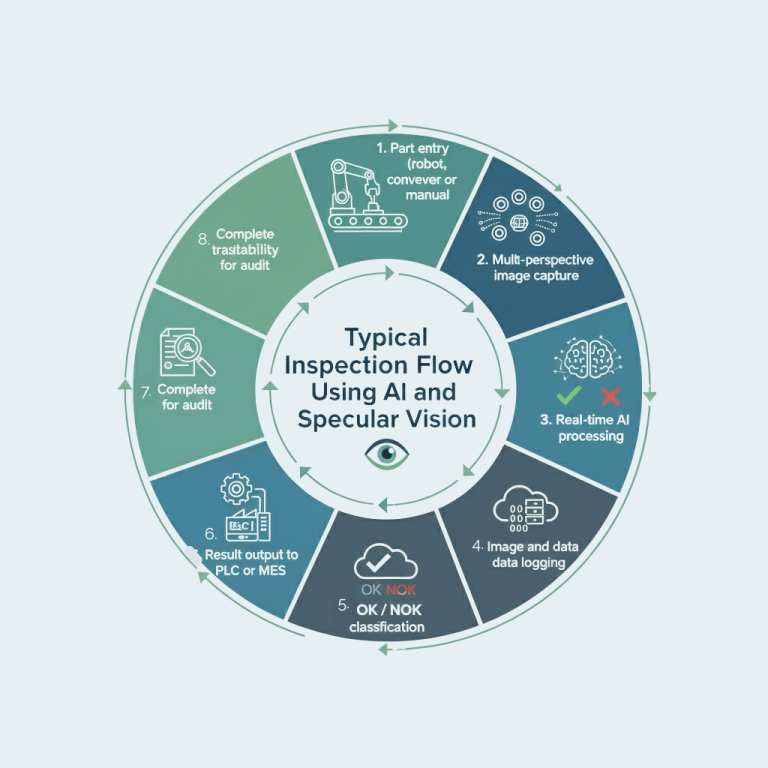
- Full traceability and PPAP-compliant data.
- Reduction of claims and line stoppages.
Tier 1
- Significant reduction in scrap and material waste.
- 100 % automated, real-time inspection.
- Direct integration into robotic cells and conveyor systems.
- Defect maps for root-cause analysis.
Tier 2
- Greater competitiveness and full compliance with Tier 1 requirements.
- Lower variability between shifts.
- Flexibility to produce multiple part references.
In many cases, manufacturers have achieved a return on investment in relatively short timeframes.
1. Interior Components
- Lacquered parts
- Black Piano trims
- Center-console modules
ISR systems are designed to detect micro-defects that are difficult to perceive with the human eye.
2. Exterior Components
- Trims
- Bumpers
- Chrome mouldings
Specular vision is essential to ensure aesthetic quality on high-visibility surfaces.
3. Machined Metal Components
- Micro-cracks
- Burrs
- Deformations
AI can help minimize rework and improve production efficiency.
4. Battery Components (EV)
Flat or glossy surfaces requiring extremely high precision.
Why Choose ISR
ISR offers clear competitive advantages over other market solutions:
✓ Real expertise in specular vision
Proprietary optical technology, specifically designed for glossy and curved materials.
✓ AI models trained with real automotive data
No generic models; each is tailored to actual automotive references.
✓ Fast integration into existing lines
Compatible with standard robots and PLCs, enabling smooth implementation without production downtime.
✓ High performance and low false-positive rate
Even in complex lighting conditions and demanding production environments.
✓ Flexibility to manage multiple references
Ideal for Tier 1/Tier 2 suppliers handling a wide variety of parts.
FAQ – Frequently Asked Questions
What defects can specular vision detect?
Scratches, waves, orange-peel texture, dents, contamination, paint imperfections, and deformations.
How fast does the system operate?
Depending on the specific application and production line, the system can inspect multiple parts per minute, even in high-speed operations.
Can it operate under variable lighting conditions?
Yes. The internally controlled illumination makes it immune to external lighting variations.
Can it handle multiple different parts?
Yes, the system allows quick changeovers between references.
Conclusion
AI-based visual inspection with specular vision represents a qualitative leap for the automotive sector. Relying on manual inspection or traditional systems that cannot detect critical defects is no longer sufficient.
Thanks to its precision, repeatability, and traceability, this technology enables:
- defect reduction,
- scrap minimization,
- improved audits,
- and achievement of zero-defect standards.
ISR helps manufacturers worldwide integrate these solutions into their lines with visible results within the first few weeks.
✉ Request a free feasibility study for your parts or production line. Our technical team will analyze your case and provide a no-obligation solution study.